


Designing a Valorant-Inspired Virtual Production Set for TEC Esports Showdown
Concept & References
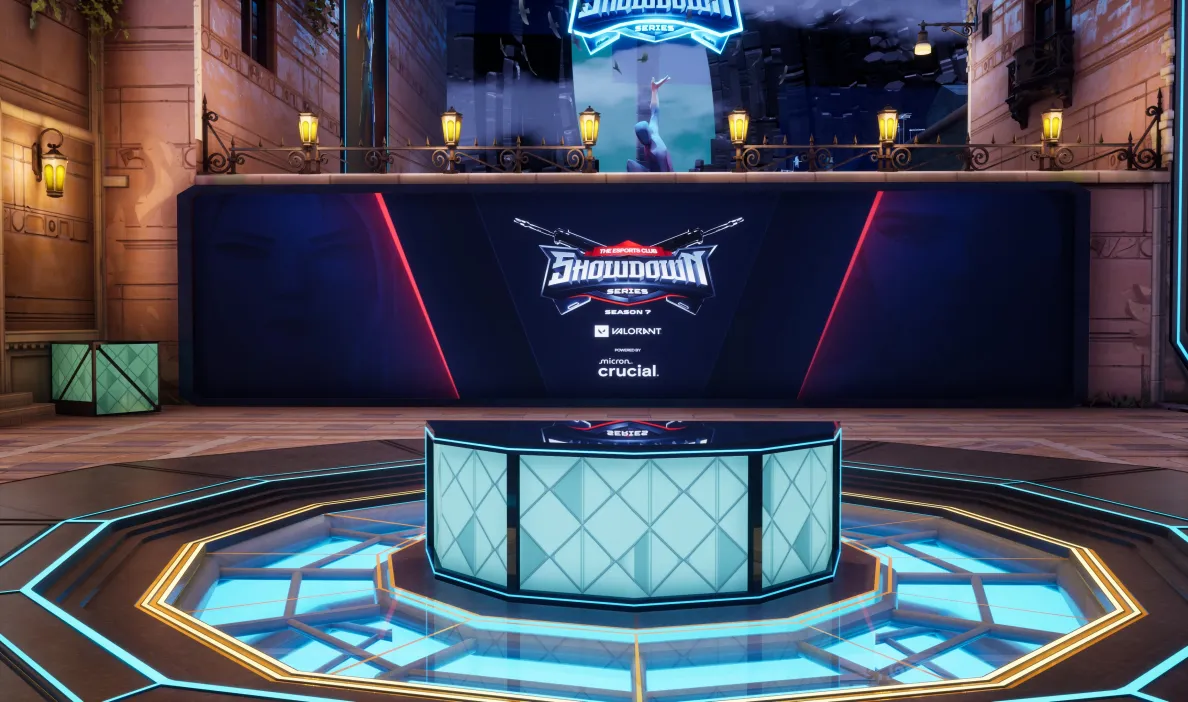
Because this was designed specifically for virtual production, the environment needed to feel like a natural extension of Valorant’s world. Our priority was to ensure that when the anchor appeared on stage, they looked integrated into the game universe, almost as if standing inside a Valorant map.
To achieve this, we studied the sci-fi, stylized design language of Valorant, referencing multiple in-game maps and assets. By blending these references into a cohesive environment, we were able to craft a believable stage that captured the atmosphere of the game while serving the needs of a professional esports broadcast.
Tools & Pipeline
The workflow for this project followed a structured pipeline to maintain both creative quality and production efficiency:
- Autodesk Maya – modeling the set and assets
- Substance Painter – texturing and detailing
- Unreal Engine – shading, lighting, and final assembly
- Infinity Set – optimization and testing for virtual production
The process began with gathering references and sketches to establish direction, followed by 3D modeling in Maya. After texturing in Substance Painter, we imported assets into Unreal Engine to finalize the look, focusing on material shading, lighting, and atmosphere. Finally, the environment was optimized for real-time use and tested in the Infinity Set system.
Environment Design
The design was guided by Valorant’s sci-fi, stylized visual identity while ensuring the set remained a functional production stage. Since talent and stage presence are the focus in esports broadcasts, the background was carefully composed to complement on-screen action without distracting from it.
We placed the virtual stage in the spawn area of the Bind map, incorporating elements such as mountains, statues, and props from other Valorant maps. By merging these details, the environment felt both recognizable to players and tailored for the TEC Showdown production.
Challenges & Learnings
Balancing Valorant’s stylized art direction with the practical needs of virtual production was one of the biggest challenges. A virtual set must exist in the middle ground of mixed reality—immersive enough to reflect the game’s world, yet realistic enough to function as a live broadcast stage.
Lighting was another critical challenge. Our initial daytime setup felt flat and lacked atmosphere. Shifting to a night scene solved that issue, but introduced new difficulties like how dark areas required careful placement of light sources to maintain visibility without losing the stylized feel. By using contrasting warm and cool tones (orange highlights against blue night shadows), we achieved both depth and visual drama.
The key takeaway from this project was learning how to merge a stylized game environment with real-world production needs. This approach allowed us to design a set that felt authentic to Valorant while being perfectly suited for live esports broadcasting.
Conclusion
This project highlighted the power of virtual production design in esports: bringing game worlds to life in a way that is both visually engaging and production-ready. By staying true to Valorant’s art style and adapting it for broadcast, our team delivered an environment that elevated the TEC Esports Valorant Showdown experience.
At FURY, we’re passionate about building hyper-realistic, game-inspired virtual sets that push the boundaries of esports and broadcast production.
-> Explore more of our work at www.xrfury.com or connect with us to bring your vision to life.
Social
.svg)
.svg)
.svg)


Get in touch!

Get in touch!
Get in touch!